
 4.0 PRObattery · on the go
 Home 230Vfor home
 Baby food warmersfrom 6 months
 Night Stationfor the night





 Cleaning Wipes Monthly Pack
 Home & 2Go Bundle
 Formula Dispenser Avent
 Baby Bottle Bundle


















A Trundle Bed or a Crib? An Honest Comparison
A side bed, a bassinet, a cradle, or a crib? This honest comparison shows what’s best for nighttime, what’s best for daytime, and what to look for when buying.

Contents
In short
For nighttime, a co-sleeper or a separate crib in the parents’ bedroom is the right choice. This way, your baby sleeps in their own bed while still being close to you. A baby cradle with a Moses basket is lightweight and practical for daytime naps near you, but it quickly becomes too small. According to the manufacturer, the LIINI® baby cradle is intended for daytime naps and when you’re on the go, not as a permanent sleeping spot for the night. Whether it’s a co-sleeper or a cradle: Your baby should sleep on their back, on a firm, flat mattress, in a sleep sack, and without a pillow.
Co-sleeper or bassinet? Before the baby is born, many parents wonder which sleeping arrangement is the right one. The honest answer: It’s usually not an either/or situation, because the two serve different purposes. Here, you’ll learn the differences between a co-sleeper, a bassinet, a cradle, and a crib, what to consider for nighttime sleep, and what to look for when making a purchase.
Co-sleeper, bassinet, cradle, crib: what’s what?
In stores and online, these terms are often used interchangeably. Here’s how to tell them apart:
- Co-sleeper: a small baby bed with an open or drop-down side that you attach directly to your bed. Your baby has their own place to sleep but is still within arm’s reach of you. In Europe, this product is governed by the EN 1130 standard.
- Baby cradle with Moses basket: a lightweight, woven or crocheted basket, often mounted on a stand. The EN 1466 standard applies to these carrying baskets and their stands.
- Cribs and wooden cradles: small beds on wheels or runners that you can move around your home. Like co-sleeper beds, they fall under the EN 1130 standard.
- Crib (beds with slats): the large bed with slats that your child will use until they become a toddler. According to the Swiss Council for Accident Prevention (BFU), cribs that comply with the EN 716 standard meet important safety recommendations.
Crib or Bassinet: A Comparison
| Criterion | Co-sleeper | Baby cradle / Moses basket | Crib |
|---|---|---|---|
| Sleeping arrangement at night | Yes, in its own bed right next to you | Only if the instructions specify it; the LIINI® bassinet is intended for daytime use | Yes, in the parents’ bedroom |
| Recommended age range | Until your baby can sit up on their own or push themselves up on hands and knees; some models can be converted | Until your baby rolls over, pushes up, or sits up—maximum 9 kg | until toddlerhood |
| Space | Requires one open side next to the parent’s bed | Small footprint, can be placed anywhere in the room | takes up the most space |
| Mobility | stays firmly attached to the parents’ bed | moves with you from room to room | stays put |
| Breastfeeding at night | short distances, baby within arm’s reach | You get up if the crib isn’t next to the bed | you get up |
| Standard (Europe) | EN 1130 | EN 1466 (basket with stand) | EN 716 |
| Suitable for | Overnight sleep, frequent breastfeeding, or bottle-feeding | Naps Near You | Nighttime sleep from day one through toddlerhood |
How long is each item suitable for? According to the EN 1466 standard, a Moses basket is intended for babies who cannot yet roll over, sit up on their own, or push themselves up on their hands and knees, and who weigh no more than 9 kg. Co-sleeper cribs, bassinet-style cribs, and cradles that comply with EN 1130 are suitable until your baby can sit up on their own or push themselves up on their hands and knees. According to the German Federal Institute for Public Health (BIÖG), bassinet-style cribs and cradles become too small after six months at the latest. The user manual is the definitive guide. You’ll find all the signs that it’s time to move to a bigger bed in the guide “Moses Basket and Baby Cradle: From When, Until When?”
At Night: A Separate Bed in the Parents’ Room
According to the Children’s Hospital Zurich, the safest place for a baby to sleep is in its own crib in the parents’ bedroom. An alternative is a crib that attaches to the parents’ bed, also known as a co-sleeper. The German guidelines for the prevention of sudden infant death syndrome (SIDS) emphasize this especially for the first six months of life. The BIÖG recommends keeping the baby in the parents’ bedroom for the entire first year of life. According to the American Academy of Pediatrics (AAP), sharing a room can reduce the risk of sudden infant death syndrome by up to 50%.
Co-sleeping and Breastfeeding: If your baby is right next to you, you don’t have to get up at night. According to the WHO/UNICEF Baby-Friendly Initiative, co-sleeping makes breastfeeding and soothing your baby easier. The AAP also cites as a benefit of co-sleeping that you can more easily feed, comfort, and keep an eye on your baby at night. This applies just as much when you’re giving your baby a bottle.
And what about the baby cradle? The manufacturer specifies in the user manual whether a cradle is intended for nighttime use. According to the product page, the LIINI® baby cradle is “intended for daytime naps and when you’re on the go—not as a permanent sleeping place for the night.” Our honest recommendation is therefore: use a co-sleeper or crib at night, and the bassinet during the day. That way, you can have your baby with you in the living room during their afternoon nap, and at night they’ll sleep in a bed designed for that purpose.
Warning
Never fall asleep with your baby on the sofa or in an armchair. The Baby-Friendly Initiative expressly warns against sofas, waterbeds, and old, sagging mattresses. If you feel yourself getting sleepy, put your baby in his or her own bed.
Safe Sleep: 6 Rules for Co-Sleeping Beds and Cradles
These rules apply wherever your baby sleeps:
- Sleeping on the Back Always put your baby to sleep on his or her back. According to the Children’s Hospital Zurich, this is the safest position. Your baby should only lie on his or her stomach when awake and when you are present.
- Own Bed in the Parents’ Room A co-sleeper or crib, at least for the first six months; according to BIÖG, preferably for the entire first year.
- Firm, flat mattress: Your baby won’t sink into it. For the crib, BIÖG specifies a maximum thickness of ten centimeters. The sleeping surface must be horizontal, because according to the AAP, a surface with an incline of more than 10 degrees is not safe for sleeping.
- No soft items in the crib —no pillows, no crib bumpers, no crib rails, no fur. According to BIÖG and AAP, you should also leave stuffed animals out, and nothing should cover your baby’s face.
- Sleeping bag and 18 °C According to the Children’s Hospital Zurich, a sleeping bag is the safest option. According to BIÖG, the neck opening should not be larger than the baby’s head. The ideal temperature in the bedroom is 18 °C. You can tell if your baby is too warm by feeling between their shoulder blades: the skin should be warm but not sweaty.
- Smoke-Free No smoking in the home or near your baby. The AAP explicitly includes e-cigarettes in this rule.
According to the Children’s Hospital Zurich, using a pacifier when falling asleep is also considered a protective factor. To learn when and how to offer it, read the guide “Pacifiers: When to Start, Proper Cleaning, and Gentle Weaning.” If you use white noise to help your baby fall asleep, you’ll find tips on volume and distance in the guide “White Noise for Babies.”
Setting Up a Co-Sleeper Correctly
A co-sleeper is only as safe as its assembly. The U.S. Consumer Product Safety Commission (CPSC) identifies gaps between the co-sleeper and the parents’ bed as a hazard, because your baby’s head or neck could get stuck in them. Here’s how to proceed:
- Read the instructions. Check to make sure the co-sleeper fits your bed—specifically, the bed frame, height, and mattress. Assemble it using only the parts provided.
- Secure itfirmly. Attach it to the parent’s bed using the straps or brackets provided. When you press against it, it should not slip.
- No gap: There should be no gap between the mattresses where your baby could get stuck. The U.S. standard for co-sleeper beds allows for a maximum gap of half an inch—about 1.3 cm—when the bed is assembled.
- Height According to Instructions There is no hard-and-fast rule that the height must be “exactly the same.” According to the CPSC, the sleeping surface on many models is slightly lower than the parents’ mattress. Adjust the height as specified by the manufacturer and make sure the sleeping surface is level.
- Proper Mattress Use the mattress that comes with the co-sleeper. It should fill the bed without any gaps. For baby beds, the BFU recommends a maximum gap of 3 cm between the mattress and the edge.
- Keep an Eye on Your Blanket Your blanket and pillow must not slide into the co-sleeper. Check the straps and screws regularly, especially after making the bed.
Checklist: What to Look for When Buying
- Standard: EN 1130 for co-sleeper beds, bassinet, and wooden cradle; EN 1466 for Moses baskets and baby cradles with baskets; EN 716 for baby beds
- The mounting kit fits your bed frame and mattress height
- Height adjustable, lying surface horizontal
- Firm mattress that fits without a gap
- Slats spaced 4.5 to 6.5 cm apart (BFU recommendation for baby cribs)
- No strings, ribbons, or cords on the bed
- Clearly stated age or weight limit
- Instructions for use that specify whether the bed is intended for overnight sleep
- Removable, washable cover
- Purchased used: all fasteners and the instruction manual are included
For a list of other essential items, see the checklist for newborn essentials.
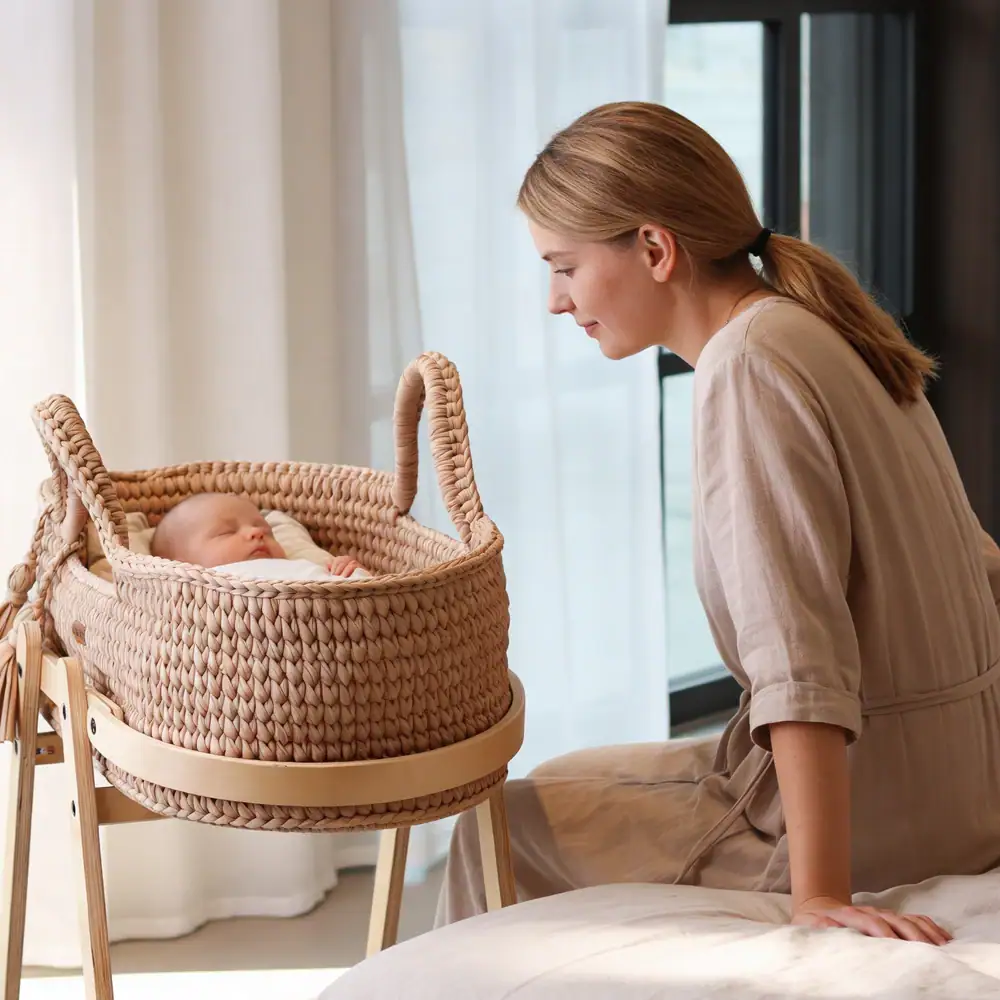
The LIINI® Baby Cradle: Made for Daytime Use
The LIINI® baby cradle consists of a hand-crocheted cotton Moses basket with a muslin mattress cover and a frame made of poplar and birch. The basket measures 760 × 390 × 250 mm, and the frame raises it to a lying height of 770 mm. According to the manufacturer, the cradle complies with DIN EN 1466:2023 and is designed for babies weighing up to 9 kg. The side pocket has room for diapers or a baby bottle. The bassinet is intended for daytime naps and when you’re on the go, not as a permanent sleeping place for the night. You can find all colors under Baby Cradles & Moses Baskets.

Frequently Asked Questions
Is a co-sleeper safer than a bassinet?
For nighttime, a separate bed in the parents’ room is safest, and according to the Children’s Hospital Zurich, a co-sleeper is an alternative to a freestanding crib. A bassinet is only suitable for nighttime use if the manufacturer intends it for that purpose. The key factors in any case are sleeping on the back, a firm, flat mattress, a sleep sack, and no soft items in the bed.
From what age and until what age can my baby sleep in a co-sleeper?
From birth. According to the EN 1130 standard, a co-sleeper is intended for use until your baby can sit up on their own or push themselves up on their hands and knees. After that, they’ll need a larger bed, unless your model can be converted according to the instructions.
Can my baby sleep in the baby cradle at night?
That depends on the model—check the user manual. According to the manufacturer, the LIINI® bassinet is intended for daytime naps and when you’re on the go, not as a permanent sleeping place for the night. For nighttime, use a co-sleeper or a crib.
Do I need both a co-sleeper and a bassinet?
You’ll need a safe place for your baby to sleep at night—such as a co-sleeper or a crib in the parents’ bedroom. A bassinet is a plus if you want to keep your baby close by during the day, such as in the living room or kitchen.
Does the co-sleeper have to be the same height as my bed?
Adjust the height as specified in the instructions. On many models, the sleeping surface is slightly lower than the parents’ mattress. It’s important that it’s level, that the bed is securely attached, and that there are no gaps.
Can I put a crib bumper in the co-sleeper?
No. According to the BIÖG, crib bumpers, bed rails, pillows, and animal skins have no place in a baby’s crib. This applies equally to co-sleeper cribs, cradles, and baby cribs.
Sources
- Information for Parents: Safe and Healthy Sleep, University Children’s Hospital Zurich and University Children’s Hospital of Basel
- S1 Guideline on the Prevention of Sudden Infant Death (AWMF 063-002, PDF), German Society for Sleep Research and Sleep Medicine and other professional associations
- The Baby’s Sleep Environment, kindergesundheit-info.de, Federal Institute for Public Health (BIÖG)
- Sleeping Safely, kindergesundheit-info.de, Federal Institute for Public Health (BIÖG)
- Preventing Sudden Infant Death, kindergesundheit-info.de, Federal Institute for Public Health (BIÖG)
- Co-sleeping in the Parents’ Bed (Parent Information 2023, PDF), WHO/UNICEF Baby-Friendly Initiative
- Brochure on Sleep (2025, PDF), WHO/UNICEF Baby-Friendly Initiative
- How to Keep Your Sleeping Baby Safe: AAP Policy Explained, HealthyChildren.org, American Academy of Pediatrics (AAP)
- Crib, BFU (German Accident Prevention Advisory Center)
- Safety Standard for Bedside Sleepers, U.S. Consumer Product Safety Commission (CPSC), Federal Register
- EN 1130:2019 – Children’s furniture – Cribs, CEN (Standard Preview from iTeh Standards)
- EN 1466:2023 – Carry cots and stands for domestic use, CEN (Standard Preview on iTeh Standards)
- Baby sleeping products, The Lullaby Trust