
 4.0 PRObattery · on the go
 Home 230Vfor home
 Baby food warmersfrom 6 months
 Night Stationfor the night





 Cleaning Wipes Monthly Pack
 Home & 2Go Bundle
 Formula Dispenser Avent
 Baby Bottle Bundle













Baby Carrier or Slings? An Honest Comparison
Wrap, ring sling, mei tai, or comfort carrier? An honest comparison with a chart and decision-making guide: Here’s how to find the baby carrier that’s right for you.
Contents
In short
A wrap adapts very well to every baby and every body type, but it takes some practice to tie. A baby carrier with buckles—the comfort carrier—is quicker to put on, and two of you can easily share it. Ring slings, half-buckle carriers, and mei tais fall somewhere in between. All of them are safe as long as your baby is in the “M” position, with their head and back supported and their face uncovered. The best way to find out which carrier is right for you is to consult a babywearing specialist.
Wrap or Baby Carrier? There’s a wide variety of baby carriers to choose from, and every family swears by something different. There’s no one-size-fits-all solution. In this comparison, you’ll learn how wrap carriers, ring slings, half-buckle carriers, and comfort carriers differ, what matters in everyday life, and which carrier is right for you.
Baby Carriers at a Glance: From Wraps to Comfort Carriers
Nora de Staël, founder of Trageschule Schweiz, sums it up in Famigros magazine: Wraps allow for many positions but require a tying technique. Baby carriers offer fewer positions but are easier to use.
Stretchy wrap
A long wrap made of stretchy fabric. You tie it in front and place your baby inside without having to retie it every time. According to babywearing consultant Michaela Lehner, it’s easy to use but needs to be tied quite precisely. Many parents like it for the first few weeks because it’s soft and cozy. The manufacturer’s label specifies the maximum weight for which an elastic wrap is suitable.
Woven baby wrap
A tightly woven fabric that doesn’t stretch. According to Michaela Lehner, woven wraps provide a secure fit and keep you warm in the winter. Thick fabrics, however, are stiff and somewhat bulky to tie. A woven wrap is suitable from birth through toddlerhood and allows for many tying styles—on the front, hip, and back. Wraps come in various lengths. If your partner also carries the baby, you may need a different size.
Ring Sling
A wrap with two rings that you wear over one shoulder. Once adjusted, you simply loosen the fabric slightly to put your baby in or take them out. Michaela Lehner describes the ring sling as very practical for when you’re out and about and for short distances. It’s most commonly worn on the hip. Because the entire weight rests on one shoulder, it’s best suited for short trips.
Caution
Carry your baby in a ring sling in an upright position and in the “M” position, not lying down in the cradle hold. According to the AAP, some slings can cause the body to curve into a C-shape, which greatly increases the risk of breathing problems. The International Hip Dysplasia Institute advises against carrying a baby in the cradle hold with closed thighs for extended periods before the age of six months.
Half-Buckle and Mei Tai
A Mei Tai has a back panel with four fabric straps that you tie. With the half-buckle style, one part has a buckle—usually the waistband—while the other is tied. According to Michaela Lehner, the Mei Tai is a good alternative for anyone who finds tying a wrap too complicated. Make sure it has an adjustable cross-back strap, especially for newborns.
Comfort Carrier (Full-Buckle)
Padded shoulder straps and a waist belt with buckles. It’s quick to put on and can be adjusted to fit different body types using the straps. The Professional Association of Pediatricians (BVKJ) states that modern baby carriers reduce the risk of improper positioning. Experts tend to view carriers with a fixed seat width with some skepticism because they only fit perfectly at a certain age. Therefore, choose a model that you can adjust to fit your baby.
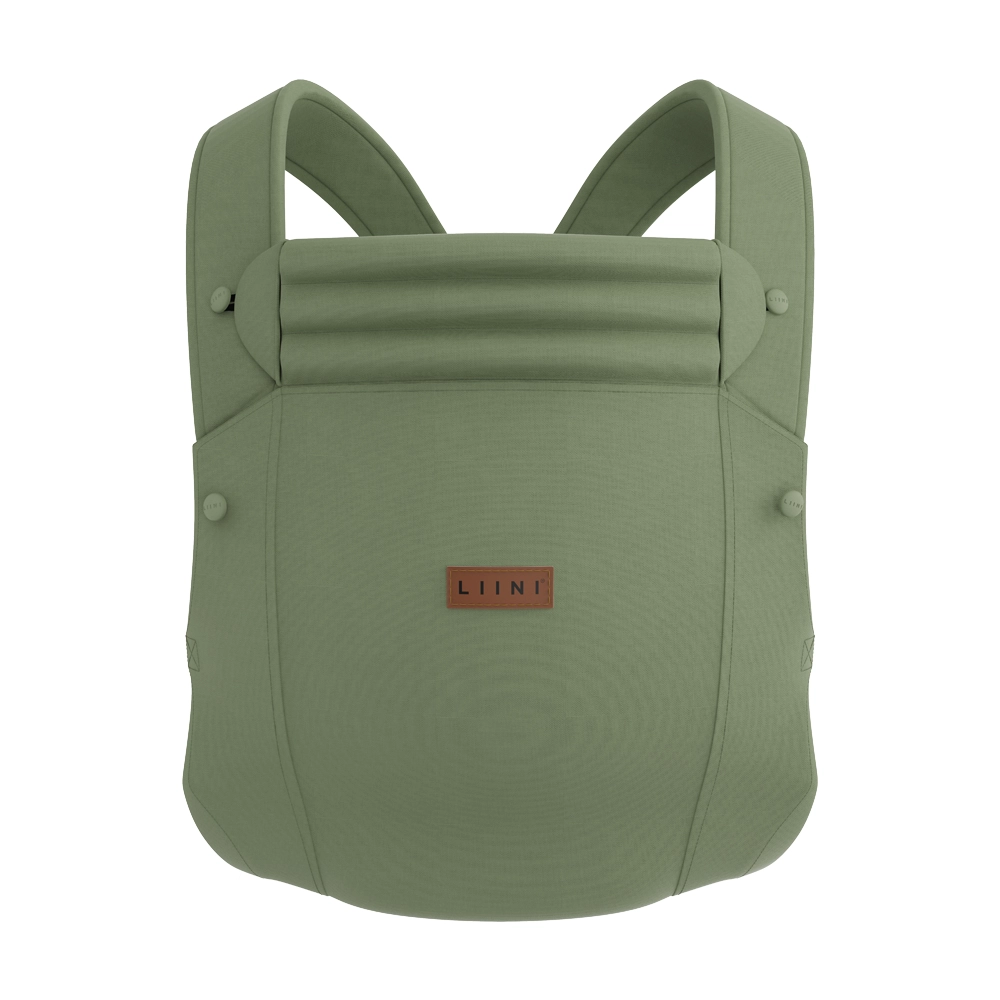
The LIINI® baby carrier is one such comfortable carrier. According to the manufacturer, it is suitable from birth for babies weighing 3.5 to a maximum of 15 kg. It features an adjustable headrest, padded, adjustable straps, and a snap closure. Depending on the color, it is made of cotton or linen.

Wrap vs. Baby Carrier: The Comparison Chart
| Criterion | Stretchy fabric | Woven wrap | Ring Sling | Half-buckle / Mei Tai | Comfort carrier |
|---|---|---|---|---|---|
| Putting it on | Tie it in advance, place baby inside | Tie it every time | Over the shoulder, tighten | Tie the straps | Close the buckles |
| Adjustment | Very fine | Very fine | Fine | Well, depending on the web | across straps and the crossbar |
| Learning effort | medium | high | medium | medium | low |
| Age | From birth; see label for age limit | Birth to toddler | Birth to toddler, rather short | Depending on the model | Depending on the model |
| Summer / Winter | Rather warm, multiple layers | depending on the fabric | one layer, fairly airy | rather airy | Padding provides warmth |
| Share with a partner | simply | The length has to be right | simply | Rebinding Books | Very easy |
| Perfect for | those cozy first few weeks | Long-lasting, many ways to tie | Short distances, hip carry | The feel of a wrap without lengthy tying | Everyday use, quick to put on |
This applies to every baby carrier: carry safely
Whether you’re using a wrap or a carrier, the basic rules are the same:
- M-position: The knees are higher than the buttocks, and the fabric extends from the back of one knee to the back of the other.
- Back slightly rounded: The torso and head need support so that the spine remains in a slightly flexed position (BVKJ).
- Face Unobstructed: The chin does not rest on the chest, and the mouth and nose are not covered by fabric or your body.
- TICKS rule: Tight, making eye contact, close enough to kiss, chin free, back supported. The Lullaby Trust recommends this mnemonic for all baby carriers.
The U.S. Consumer Product Safety Commission (CPSC) advises exercising special caution when using baby slings for infants under four months old. For detailed instructions on how to safely carry a newborn and follow the TICKS rule, see the guide “Baby Carriers: When to Start?”
Tip
Before each use, quickly check your baby carrier for torn seams, loose buckles, and frayed straps. This is recommended by the Australian Competition and Consumer Commission (ACCC). For baby carriers, you can also look for compliance with the European standard EN 13209-2 for soft carriers.
Wrap or Baby Carrier: Which One Is Right for You?
Three questions can help you get started:
- You want to get started right away, without much practice: A comfort carrier is quick to put on and quick to adjust.
- You enjoy tying it and want maximum customization: A wrap adjusts centimeter by centimeter. Stretchy for the first few weeks, woven for long-term use.
- Frequent in-and-out trips, short distances, a sibling holding your hand: A ring sling adjusts quickly.
- The feel of a wrap without the hassle of tying: A half-buckle carrier or Mei Tai is a good compromise.
- You both carry your child and are different heights: The easiest way to do this is with a comfort carrier with adjustable straps.
Many families end up with two baby carriers: a wrap or sling for home and short trips, plus a carrier for long walks. Nora de Staël reminds us that babywearing isn’t a rule set in stone. If a stroller works well for you, that’s fine, too.
Summer, Winter, and Carrying as a Couple
In the summer: Babies haven’t yet developed the ability to regulate their body temperature well, and your body heat adds to that (BVKJ). Choose lightweight fabrics like linen or thin cotton, dress your baby more lightly, and seek out the shade. The Raising Children Network advises against using baby carriers altogether in hot weather. According to the Swiss Cancer League, babies under one year of age should not be exposed to direct sunlight. You can find more tips for hot days on the go in the guide “Traveling with a Baby.”
In winter: It’s best to carry your baby under a loose-fitting jacket, or with a babywearing jacket or cover. A thick onesie makes it difficult to fasten the carrier snugly and position the legs in an “M” shape.
Carrying as a pair: You can switch a comfort carrier to the other person in just a few simple steps. With wraps, it depends on the length: If your partner is much taller or shorter, you might need two wraps. Ring slings and mei tais are easy to share, but they need to be readjusted each time.
Try them out and get advice
The best way to find what works for you is to try out different baby carriers on your own body. Independent babywearing consultants will show you several models, often first using a practice doll and then with your baby. In some cantons, parenting counseling services also offer courses, such as the one in the Canton of Bern called “Basics of Safe Babywearing.”
Here’s how to get the most out of your consultation:
- Choose a Time: Schedule the session when your baby is full and well-rested.
- Bring whatever you have. Bring any wraps or carriers you have, including ones you’ve been given or borrowed.
- Come as a couple: If both of you want to carry the baby, both of you should practice.
- Wear Appropriate Clothing: A tight-fitting top shows better how the carrier fits.
- Write down any questions —for example, about C-sections, back pain, or carrying on the hip.
- Practice at home: Put on the carrier several times over the next few days until it fits properly.
If you already have a LIINI® baby carrier, our experts will check your fit for free based on three photos. You can find all the details in the free babywearing consultation.
Frequently Asked Questions
Is a wrap better than a baby carrier?
Not necessarily. A wrap can be adjusted very precisely, but it takes practice. A baby carrier is quicker to put on. According to the Professional Association of Pediatricians, modern baby carriers also reduce the risk of improper positioning. The key is that your baby is in the “M” position and can breathe freely.
Which baby carrier is best for newborns?
For newborns, wraps and carriers that can be adjusted to a small enough size and provide support for the head and neck are suitable. When choosing a carrier, make sure to check the minimum weight requirement and look for an adjustable waistband. The BVKJ recommends using carriers without an adjustable waistband or a newborn insert only once the baby can sit up on their own.
What is a ring sling, and is it safe?
A ring sling is a piece of fabric with two rings that is worn over one shoulder. It is safe when your baby is sitting upright in the “M” position, with their face clear and their chin not resting on their chest. Avoid the cradle hold with a curved body, especially with young babies.
What is the difference between a Mei Tai and a half-buckle carrier?
With a Mei Tai, you tie the hip and shoulder straps. With a half-buckle carrier, one part has a buckle—usually the hip strap—and the other is tied. Both offer a similar carrying experience to a wrap but are quicker to put on.
Can I share a baby carrier with my partner?
Yes. A comfort carrier can be adjusted in just a few simple steps using the shoulder straps and waist belt. With wraps, you may need two different lengths if there’s a significant difference in height between you and your partner. It’s important to check the TICKS rule after every adjustment.
Do I need a different baby carrier in the summer?
Not necessarily. Lightweight fabrics like linen or thin cotton, combined with a single-layer tying method, are more breathable. Dress your baby in lighter clothing, seek out the shade, and avoid carrying your baby altogether when it’s hot.
When can I start carrying my baby?
From birth, as long as the wrap or carrier is suitable for your baby’s weight and fits properly. You can read all about getting started with newborns in the guide ” Baby Carriers: When to Start?“
Sources
- Wrap Slings, Baby Carriers, and More: An Overview of Popular Baby-Carrying Aids, schwanger.at, with Michaela Lehner (Die Trageschule® Austria and Switzerland)
- Baby Carriers and Wraps: What Parents Should Know, Famigros, with Nora de Staël (Trageschule Switzerland)
- Baby Carriers: The “Most Natural” Way to Carry a Baby—Be Aware of the Risks (KinderPraxis 4/16), Professional Association of Pediatricians (BVKJ)
- Baby Carriers: Backpacks, Front Packs & Slings, HealthyChildren.org, American Academy of Pediatrics (AAP)
- Infant Deaths Prompt CPSC Warning About Sling Carriers for Babies, U.S. Consumer Product Safety Commission (CPSC)
- Baby Carriers & Other Equipment, International Hip Dysplasia Institute
- Baby Slings and Carriers, The Lullaby Trust
- Guide to Baby Carriers, Wraps, and Slings, Australian Competition and Consumer Commission (ACCC)
- Safe Babywearing: Choosing and Using Baby Carriers, Slings, and Backpacks, Raising Children Network
- Sun Protection for Children Aged 0 to 6, Swiss Cancer League
- Basics of Safe Babywearing, Parenting Counseling Service of the Canton of Bern
- Tragelfen Switzerland Association: Babywearing Counseling, Tragelfen Switzerland Association
- EN 13209-2 Baby Carriers – Safety Requirements and Test Methods – Part 2: Soft Carriers, CEN (iTeh Standards Catalog)